Our Winter Vacation '05 Highlights - Page 4
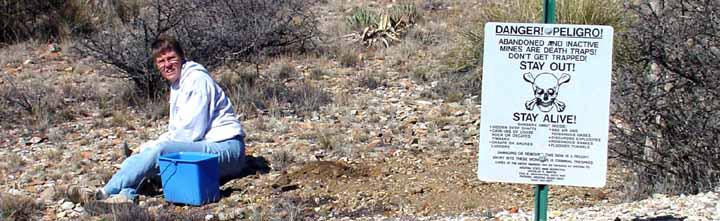
After Don and Jeanne left us, we continued to venture out from our home base at St. David. We had bought a book on rock hounding and so we decided to try our luck in locating some interesting rocks and minerals. On our first try, close to our camp at St. David, we attempted to find some Desert Rose (a form of Selenite), but we were not too successful because we ran into some no trespassing signs. However, the man at the local rock shop later told us that we should have continued on anyway "because everyone ignores the signs". Later, we drove the jeep up into the Dragoon Mountains to where we found some old mine diggings and tailings, and where some ominous signs were posted that displayed a skull and cross bones. They warned of the very deep pits that one could fall into, and of other dangers.
 |
 |
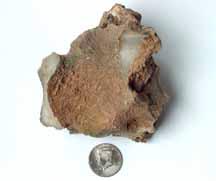 |
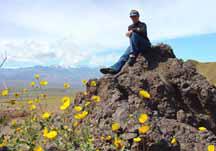
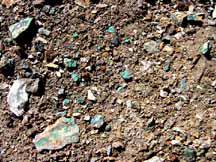
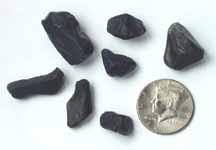
At the particular place shown here where Diana was digging, we found some tiny bits of Turquoise in the tailings that showed up with the typical beautiful blue-green color. In other mine tailings we found samples that showed metallic minerals. It was fun taking the jeep up into the mountains where the elevation was 5,000 to 6,000 feet. At this height, the desert vegetation changes into larger trees with less cactus; it is cooler, and there is obviously much more rainfall, which is responsible for the dry washes found at lower elevations. In the dry washes, we also located other interesting rocks, some of which the local rock shop identified as Opal. At another place, just off a main highway we found Apache Tears scattered around on the flat desert ground. These are small, black, glass like obsidian rocks that are of volcanic origin.
 |
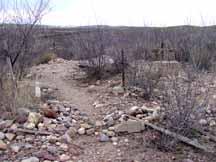 |
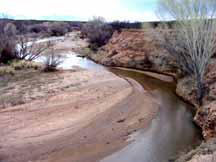
On another outing, we went to the San Pedro Riparian National Conservation Area and took a 4 mile round trip hike up the San Pedro river from the ghost town of Fairbank to the ruins of the Grand Central Mill, following an old town roadbed. Before finding the ruins, we took a short detour to the old Fairbank cemetery, which is now a lonely desolate place on the knoll of a small hill and crying for some attention. The Grand Central Mill is one of many stamping mills that were built along the San Pedro River during the silver boom years in the town of Tombstone. The silver-bearing ore was brought from the town to the river by mule trains and then pounded to powder by large iron stamping rods that echoed a thundering noise throughout the countryside. Mercury was then used to separate the silver from the powder.
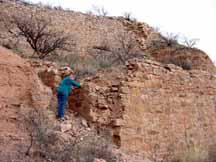 |
The masonry work from the mill foundations are all that is now visible from the large building that once stood here. From the mill, we followed a small trail next to the river back to the ghost town of Fairbank. On this trail, we saw discarded clothes left here and there that we figured were from illegal immigrants heading north. Although we saw no one on this remote trail, we wondered if we were being watched. What we really had in the back of our minds, however, is that a similar trail, right here where we were next to the river, is what Francisco Vasquez de Coronado followed with his group of several hundred Spaniards on his way north from deep in Mexico in 1540; the first Europeans to enter into the center of North America (as far as Kansas), and 80 years before the pilgrims landed (over 450 years ago).
 |
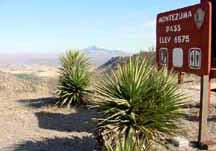 |
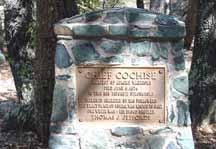
Other side trips we took included the Cochise Stronghold where the Apache chief had his headquarters and where he is buried. We also visited Fort Huachuca, an active army post, with interesting museums highlighting army history in the area. We went to the Coronado National Memorial, which is a national park on the Mexican border that commemorates the first entry of Europeans into what is now the Southwest United States. In the park we took a narrow mountain road to the top of Montezuma Pass (at 6,575 feet) where we had a long vista, both east and west, along the Mexican border. We also visited the mining ghost towns of Pearce, Courtland, and Gleeson. Gleeson is where the early Indians first mined for Turquoise for use in jewelry. Then the Tiffany Company later mined the gem here (could that be where they got their signature color from?), while others mined for copper, lead, and zinc.
 |
 |
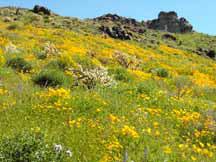 |
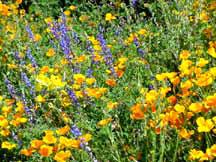
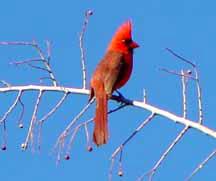
It was finely time to leave our base in St. David and to start heading north. We said goodbye to the scarlet bird that we saw near our campsite and then headed out. Our route first took us to Casa Grande and the Western Horizon Resort there, then to Camp Verde and the Western Horizon Resort there, and then to Kingman, Arizona where we stayed for a couple of nights. While in Kingman we took a side trip to Oatman, Arizona, and passed by some beautiful wild flowers on the way that festooned the hillsides with bright colors. Oatman is a former gold mining town on old Route 66 that was named in honor of Olive Oatman who was a young girl when she was kidnapped in 1851 by Mojave Indians and then rescued in 1857 near the current site of the town.
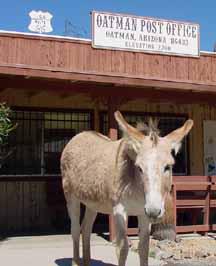 |
Gold was discovered near Oatman in 1902 and a tent mining community was established producing some 3 million dollars in gold. In 1915 more gold was discovered and by 1936 it is estimated that 36 million dollars worth had come from the local mines. The town then had two banks, seven hotels, twenty saloons, and almost 20,000 people. Now, the town with about 200 people is overrun with burros that are descendants from the ones that remained when all the miners left town after it went bust. Even though the burros are deemed to be wild, the tourists who hug them and feed them carrots have certainly tamed them. The town's other claim to fame is that this is the place where Clark Gable and Carole Lombard spent their wedding night in March of 1939. It was at the Oatman Hotel (in room #15) where they went to be alone after being married in Kingman. Yes, we saw the room. It's been refurbished to the time period when they were there. The hotel was built in 1921 and has eight rooms. It is believed to be the only two-story adobe building in Mojave County, and it is listed as a historic building in the National Register. This town is now a tourist trap where the tourists are literally trapped on the one thru street, between burros, cars, RV's, and staged gunfights. This is truly an old west town that you can spend a lot of time in while soaking up the atmosphere.
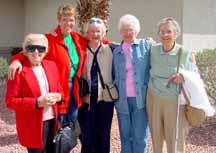 |
Our next stopover was Las Vegas for two nights at Sam's Town Casino RV Resort. While there, we picked up Dave's mother at the Las Vegas airport for her annual get together with the sister-in-laws. We did spend some time visiting with them, going to the Gold Coast Casino for a dinner buffet and going to breakfast at a local restaurant. It was the first time Dave had met Millie and to see all the sister-in-laws together. They always have fun in this annual affair and they seem to enjoy each other's company. It would be fun to know what Dave's dad and his brothers would think about their wives and sister getting together like this, but they are now long gone from this world.
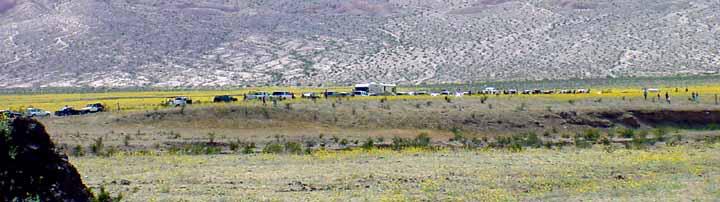 |
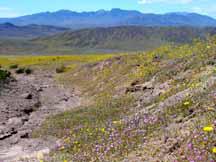
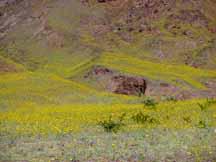
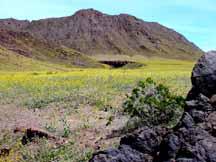
We then moved on to Pahrump, Nevada (about 60 miles west from Vegas) where we stayed for a week at the Charleston Peak Western Horizons Resort. While in Pahrump, we made a side trip back into Death Valley because it was reported (on the national news) that the valley was in full bloom with wild flowers; the best bloom seen in many years. As you might guess, the roads in the park were filled with vehicles and with tourists pointing their cameras everywhere. We joined them, but decided to park off the road and hike a mile out into and among the flowers. It was a beautiful day and the trip was worth it. For miles, the flats and the hillsides were glowing with yellow. Only when you got up close could you see the other colors of red, pink, blue and white of other flowers. Due to the lack of adequate moisture, this blooming event is not often seen in most years, and we felt lucky to be here. The desert can be a beautiful place, even in a place called Death Valley.